
Furnishing a new or recently allocated home raises a question rarely addressed in usual decor guides: how to translate current trends into a space that is often compact, with standardized white walls, and on a tight budget? First-time buyers in social housing face specific constraints (limited space, prohibition on drilling certain load-bearing walls, imposed coverings) that make most general advice inapplicable as is.
This article compares decoration spending categories based on the type of housing, then analyzes concrete levers that allow for personalizing an interior without heavy renovations or budget overruns.
Decoration Spending Categories: New Social Housing vs. Standard Rental
The allocation of the decoration budget changes depending on whether one moves into a new social housing unit or a private rental. In a new social housing unit, the walls are delivered painted white, the floors are often vinyl or light tiles, and the kitchen is minimally equipped. The tenant does not have to finance any repairs, but they also cannot modify the wall coverings without the landlord’s agreement.
| Spending Category | New Social Housing (constraints) | Standard Private Rental |
|---|---|---|
| Wall Paint | Often prohibited or subject to agreement | Generally allowed (neutral colors) |
| Floor Covering | Imposed, non-modifiable | Sometimes modifiable (floating parquet) |
| Lighting | Fixed light points, free addition of lamps | Same, more flexibility on suspensions |
| Furniture | Main budget, often limited | Variable budget, broader access to custom options |
| Wall Decoration | Light fixings (adhesive, picture rail) | Drilling allowed with patching |
This table highlights a point rarely emphasized: in social housing, furniture and lighting account for almost the entire decoration budget. The walls and floors, locked by the landlord, do not provide a lever for action. Therefore, any decoration strategy must rely on mobile and reversible elements.
Resources like maisoncrea.fr allow for exploring creative avenues suited to these constraints, focusing on furniture, textiles, and decorative objects.
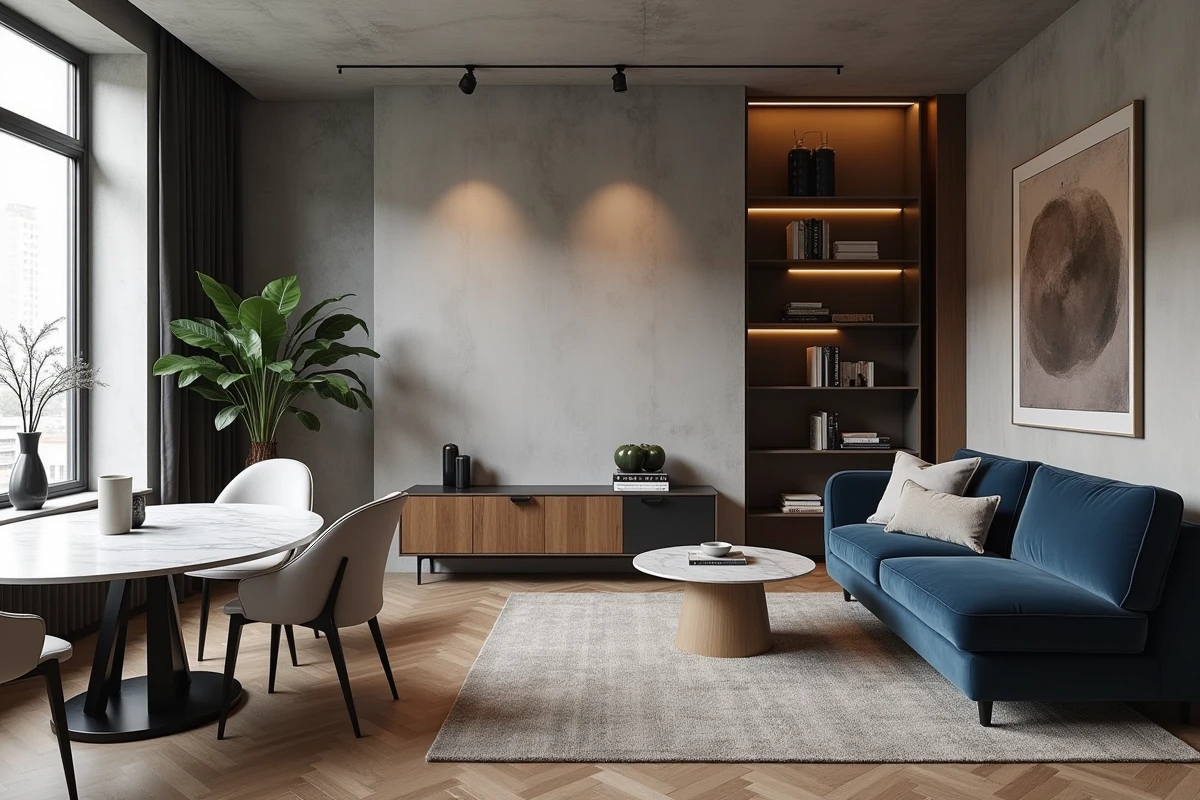
Wall Decoration Without Drilling: Techniques for Constrained Housing
The prohibition on drilling walls (common in social housing, sometimes contractual in private rentals) immediately eliminates fixed shelves, large heavy frames, and traditional curtain rods. Three families of solutions exist, each with its limits.
- Repositionable adhesive strips support lightweight frames (less than one kilogram per fixing point) and leave no trace. They lose their adhesion in humid rooms like the bathroom or kitchen.
- Self-adhesive picture rails, placed at the top of the wall, allow for hanging multiple frames on a wire. The system is modular and requires no holes in the partition.
- Decorative masking tape (washi tape) creates geometric patterns directly on the wall. The effect remains graphic as long as contrasting colors are chosen with the standard white of new housing.
These techniques do not replace a true gallery wall, but they transform a bare wall into a dressed surface for just a few euros. The checkerboard pattern, a decor trend noted in 2026, lends itself particularly well to washi tape: two rolls of alternating colors are enough to create a one-square-meter wall panel.
Multifunctional Furniture for Small Spaces: Key Trade-offs
In a small living room, each piece of furniture should serve at least two functions. Decor guides often recommend “statement” pieces (an oversized sofa, a sculptural coffee table), but this advice is aimed at spaces over twenty square meters.
For a compact living area, a convertible sofa with integrated storage replaces both the guest bed and the auxiliary wardrobe. The additional cost compared to a simple sofa pays off by eliminating the need to purchase a separate storage unit.
Reclaimed Wood and DIY: An Alternative to New Furniture
Wood remains the most cited material in the 2026 decor trends, but a new solid wood piece represents a high expenditure. DIY (shelves made from stacked wine crates, coffee table from sanded and varnished pallets) reduces the material cost to almost nothing.
This approach requires time and a minimum of tools. An orbital sander and a matte varnish are enough to transform a raw pallet into a usable surface. The result fits well in both Scandinavian and industrial styles, two aesthetics that work with the light floors and white walls typical of new housing.

Colors and Textiles: Personalizing an Interior Without Touching the Walls
When painting is prohibited, color comes in through textiles. Curtains, cushions, rugs, and throws provide the quickest and least expensive lever to change the atmosphere of a room.
A dark-colored rug placed on a light vinyl floor visually anchors the living room and delineates the living area in a studio or one-bedroom apartment. Textiles are the first category to prioritize when walls and floors are fixed.
Combining Colors Safely in a Neutral Space
The white walls of social housing offer an often underestimated advantage: they accept any color palette. Where a taupe or terracotta wall imposes specific combinations, white leaves the field open.
A simple rule works in most cases: choose a dominant color for large textiles (curtains, rugs), a complementary color for cushions and throws, and keep the rest neutral. A maximum of three colors in the room avoids visual overload, especially in small spaces.
Decorative objects in wood, ceramic, or metal add texture without adding color. A stoneware vase, a brass candlestick, or a round mirror are enough to break the monotony of a shelf.
Adapting decor trends to a tight budget does not require sacrificing style. The constraints of social housing (non-modifiable walls, limited space, tight budget) naturally lead to reversible, modular, and often more creative choices than the turnkey solutions offered in mainstream catalogs. Textiles, multifunctional furniture, and DIY wood remain the three categories where every euro invested produces the greatest visible change.